Hi Folks!
It
has been a long time since i wrote anything on the blog. And my crammed
schedule left me with no thought to read or write anything related to
history at the present moment. But a chance recent event perforce made
me scribble my thoughts here.
This
post is different from all the posts written on the blog till now
- it's not intended to simply share information / findings of any
historical event /
person etc, but to clear the air around certain claims made in a book by a renowned Indian author / historian.
Let
me introduce the book and the particular details in it that
necessitated me to write this post. The book, which was brought to my
notice recently, is titled "The Forgotten Mughals" and is authored by the historian, Mr. G S Cheema. It mentions that the medieval Maratha icon, Peshwa Bajirao I was defeated by Nasir Jung, the eldest son of the first Nizam in the Deccan, Nizam-ul-Mulk Qamruddinin in a battle that was fought in 1739-40 & that the Peshwa was then made to sign a "humiliating treaty" by Nasir. It was incidentally the last battle fought by the 'invincible' Peshwa. The book further furnishes "evidence" that the Peshwa, known popularly as Rau, was so broken that he wanted to end his life by taking poison.
 |
The only contemporary painting of 'The Fighting Peshwa' ,
on a stamp released by India Post.
This was with the family of Pilaji Jadhav*, a trusted aide of Bajirao.
This is now present at the Bhartiya Itihas Sanshodhak Mandal, Pune, India. |
|
* - Pilaji Jadhav was a Maratha subedar who served Chatrapati Shahu ji for around 30 years. He was a close associate of Peshwa Bajirao.
Now, Peshwa Bajirao is rated among the finest cavalry leaders known in military history,
and is famous for not losing a single battle in his military career
spanning around 19-20 years. Hence, the details in the book perplexed me, and, i am sure, would have caused consternation among Maratha history enthusiasts.
Here is the snippet from the book which is under consideration in this post.
{
The entire chapter which contains the description of the
'alleged defeat of the Peshwa' is posted in Appendix 1 at the end of the post, for interested readers.
}
 |
Extract from
Page Number 176 of the book Forgotten Mughals.
It is claimed in this extract that Bajirao wrote to his brother Chimnaji that he wanted to give up his life by
drinking poison.
|
|
 |
Extract
from Page Number 177 of the book Forgotten Mughals.
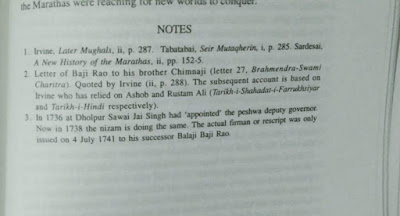
There are just a few references given at the end of a chapter spanning over
10 pages, contrary to the list of detailed references that generally supplement any book on history. |
We shall look at the points mentioned in this extract one by one. Before
proceeding ahead, it's important to mention that
history is such a discipline
where difference of opinion about certain events in the past is bound
to occur. There are certain topics on which conflicting references can
be found and, often, agreement on a particular conclusion /
interpretation is not
possible. However, the present case is different. The facts are recorded
by multiple sources in a clear manner and there is no scope for dispute
regarding who the actual victor was and who was forced to sign a treaty
for compromise.
The post can be divided into 2 parts:
Ist:- Verification of references given by the author in his book.
IInd:- Providing counter references to show that Peshwa Bajirao was victorious in the said battle.
***********************************************************************
Section I
Verification of References Given in the Book "Forgotten Mughals"
Let us start by checking the references which the author has presented in the notes to the particular chapter under consideration.
1. The author has cited the book Later Mughals, Part II, Page number 288 in the notes and mentioned that a certain letter number 27 has been quoted there. He has based his theory that the Peshwa wanted to die on his interpretation of this letter.
Here is page number 288 from the same book, Later Mughals. Let's see what this page and the letter quoted on the page 'actually' say.
 |
Contrary to the claims made in the book under consideration,
page number 288 of Later Mughals, Volume II, by Irvine, nowhere says
that Bajirao was in deep pain or wanted to die by taking poison.
Instead, the letter (number 27) on this page says that Bajirao wanted to burn* Delhi in order to
demonstrate to the Mughal Emperor that the Marathas were a force to
reckon with and that they could not be wished away. |
{
* - Bajirao did not actually 'burn' Delhi. This was just an expression of the anger he felt at the Mughals at the time of writing this letter. The reason behind his anger shall become clear soon.
}
It can be seen clearly that the letter (number 27) has been misinterpreted by Mr. Cheema in his book. While the letter in Irvine's book Later Mughals mentions the Peshwa's intention to attack Delhi to intimidate the Mughal Emperor and to show him the might of the Maratha army, Mr. Cheema has referred to it to claim that Bajirao wanted to kill himself.
A pertinent point here is that the letter and events (from the book Later Mughals by Irvine) are related to the time Bajirao attacked Delhi in 1737 & had the Mughal capital at his mercy. Mr. Cheema has presented these events of 1737 as an 'evidence' of the (alleged) defeat of the Peshwa against Nasir Jung in 1739-40!
In other words, he has used a letter that the Peshwa wrote to his
brother in 1737 to "show" that the Peshwa was dejected enough to wish to
die after his 'defeat' in a battle in 1739-40.
Here, it is important to clarify that i am not rejecting the clause that Bajirao was under debt. It should be kept in mind that Bajirao (or even Chatrapati Shahu)
were almost always under debt. The Marathas were not rich like the
Mughal Empire. They financed their operations by taking loans. Bajirao
took loans from Babuji Naik Joshi, who was the brother of his sister Bhiu Bai's husband. But i object to the suggestion in the book that debt led to Bajirao's death. Debt & Death of Bajirao are two different issues.
_____________________________________________________
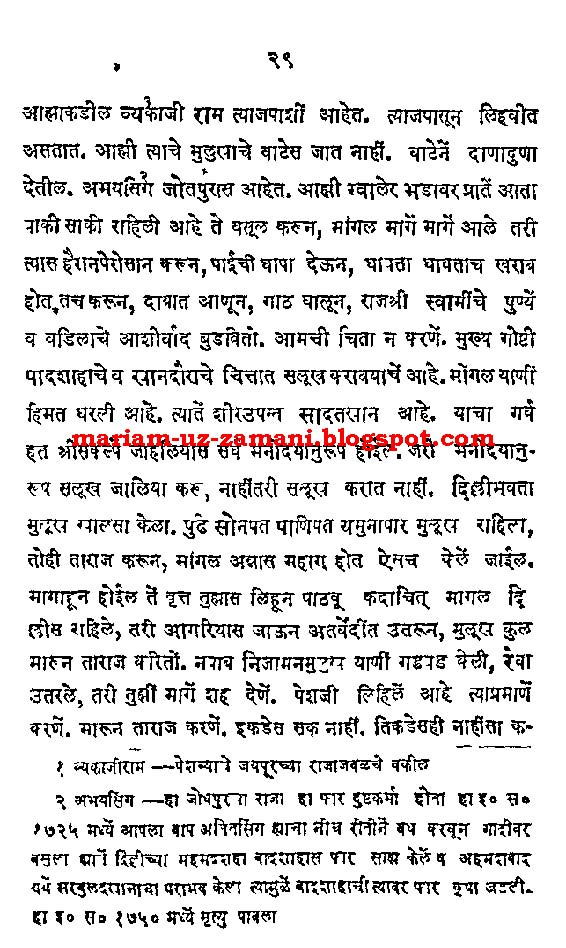
2.
Let us now read and understand the complete letter (number 27), written by Peshwa Bajirao to his brother Chimnaji Appa, referred to by Mr. Cheema from Irvine's Later Mughals, Vol. II, page number 288, in order to remove any lingering doubts regarding
its contents.
The letter talks of Bajirao's anger at the Mughals for boasting in front of the Emperor that they had defeated Bajirao. In this letter, Bajirao explains to his brother about his plans to handle the 3 big armies of Mohammad Bangash, Saadat Khan and Khan Dauran, who had converged together to block Bajirao's movement towards the imperial capital city of the Mughals.
Before
introducing the letter, let me present its background, that is, why
Bajirao wrote this letter to his brother and why he was so infuriated
with the Mughals at the time.
One of the Maratha generals, Malhar* Rao Holkar had suffered reverses in a battle (fought on 12th March, 1737) against the Mughal general Saadat Khan at Etawah (in present day Uttar Pradesh).
{
* - A distinguished Maratha subedar. He served under Peshwa Bajirao / Chatrapati Shahu Maharaj. Later, he established the independent Holkar dynasty at Indore.
}
Holkar and his army had to leave the battlefield and, after great hardships, reached Bajirao who was near Gwalior then. Many Marathas were killed during the retreat, some being drowned in the Yamuna. Bajirao was not present in this battle but he monitored these movements carefully (through his agents / letters).
Bajirao came to know from his sources in Delhi that the Mughal generals had reported their 'success' (over Holkar) to the Mughal Emperor in 'highly inflated' terms and called it a "victory over Bajirao". Moreover, they reported that Malhar Holkar was killed by the imperial forces! This infuriated Bajirao and he vowed to teach a lesson to the Mughals by going to Delhi and sacking / burning it right under their noses!
It was in this frame of mind that the Peshwa wrote this letter. Note the minute details which the Peshwa mentions about the movement of his enemies and his wise decision of not attacking Agra directly because the natural terrain of that plain was not to his advantage. Moreover, the Mughal strength at Agra had grown manifold after the arrival of Khan Dauran & Muhammad Bangash to the camp of Saadat Khan.
The letter is in the Marathi language[1], and can be read by interested readers in its entirety along with its English translation in Appendix 2 at the end of this post.
(
Incidentally, the letters
exchanged by Bajirao and Chimanaji Appa used to be sent to Shahu
Maharaj also for his understanding of the situation and to keep him informed about the wars they fought.
)
Here is the partial English translation.
Note:
Words in (normal () brackets) are not present in the original letter. They are my own insertions to make the meaning clear.
Statements in {curly {} brackets} are given to give a better understanding of the background of the events / places / people under consideration.
"
April 5th 1737
Shri Chiranjiv Rajashri Appa
(letter addressed to Bajirao's brother Chimnaji as per old custom; chiranjiv means roughly -
chirantar jiwit - or a wish for the long life of the addressee),
Blessings from Bajirao Ballal.
(I
am) staying near Savai Jainagar. Writing (informing you) that I am
well. Handed over my heavy luggage & sent some friends to
Bundelkhand's King Jagatraj, and became unencumbered.
{
Savai Jainagar means Jaipur in Rajasthan. Savai
Jaisingh built the city in 1728, so it used to be referred as Savai Jainagar.
Jagatraj was the 2nd son of Maharaja Chhatrasal Bundela of Bundelkhand, and he considered
Bajirao his brother. He was a staunch supporter of the Marathas, and always used to be privy to the discussions/plans of Bajirao, in his battles.
Readers may recall that Bajirao had met Mastani in Bundelkhand.
}
About this (arrival of sardars in Bajirao's camp) and about war with
Saadatkhan (the war in which Malhar Rao suffered reverses), have written all detailed information in the letters sent with
messengers. You must have got them and
learnt all details. Saadatkhan crossed the Yamuna
river and went to Agra. I would have faced him but, he has sheltered himself in Agra. If I
go there to fight war with him, he is in their refuge (safe place), so situation unpredictable (if i fight a war with him at his safe refuge in Agra).
{
Saadatkhan
Mohammad Amin - originally from
Khurasan, started out as a trader, rose to great heights in the Delhi
darbar and was given Subedari of Awadh or Ayodhya after Raja Giridhar in
1724.
Was given the title of Barhan-ul-mulk.
}
If
i have to stay at sangam of Gambhir (river) and Yamuna, this place has
many ravines (so i cannot stay here). Khan Dauran (Abdul Samdar khan
also referred as Mohammad Ashim) and Mohmmand Khan Bangash were on the
way to Agra from Delhi. If they join Saadat Khan, situation might become
difficult (as their armies would swell to a great extent and it will be tough to fight all 3 together!). This is (also) the reason it is not fine to stay here at sangam.
{
Mohammad
Khan Bangash, was the subedar of Allahabad. He harassed Maharaja
Chhatrasal Bundela of Bundelkhand a lot. So Bajirao had attacked and
defeated him in 1729. Bangash once escorted the mother of Bajirao - Radhabai, when she went for a pilgrimage to Varanasi !!
}
Secondly, Saadat Khan has written to the Padshah (Mughal Emperor) and Khan Dauran and Kamaruddin Khan etc. amirs that - " the Maratha army had come
down from Yamuna and he (had) defeated it. Saadat Khan
wrote he has killed 2000, also 2000 more were sunk in the river and Malharji
Holkar and Vithoba Bule were killed. Bajirao had attacked but he (Saadatkhan) turned their army into this
state. Bajirao hasn't much army left, so
Saadatkhan will pursue them beyond the Yamuna and will push them beyond the Chameli (Chambal) river."
Such
tales (made up stories) Saadatkhan has written !
{
Khan Dauran's original name was Abdul Samdar Khan. He was also
known as Khwaja Mohammad Ashim. He was given a mansab of 7000 by the Mughal Emperor, Jahandarshah. Mohammad Shah gave him refuge and titles like Shamshaam-ud-daula, Khan
Dauran, and Mansurjang Bahadur. The Marathas used to refer
to him as Khan Dauran. He used to maintain good relations with them. He
was an elderly, well-respected man.
It can be seen in the letter below that Bajirao
had due respect for him and believed that Khan Dauran was in favour of
better relations between the Mughals and the Marathas.
}
Saadatkhan bowed before the Padshahah and
he was awarded robes, pearls, necklace, an elephant and headgear. The Padshah gave
headgear to his vakil also. Saadatkhan made himself safe (strong) in this way. This
was informed (to me) in detail by Dhondo Govind
(the Peshwa's representative/vakil in Delhi).
In short, Saadatkhan claimed (in front of the Emperor) that our army has lost its will, he has destroyed our
army and sunk them. (All) Lies! - ('lapandav' - literal meaning - hide and seek game. Here it means that Saadatkhan hid the truth and presented
his own fake version to the Mughal Emperor).
(But) we (means Chimnaji and Bajirao) know. We have heard how the Mughal
system works. They perform small deeds and boast about inflated tall claims !
The Padshah believed Saadatkhan. So now have to
bring out Saadatkhan's lies in front of him. There are 2 ways - one, defeat Saadatkhan or, two, go to Delhi and burn it, so
they will know his lies (about the state of our army).
Seeing Saadatkhan is not leaving Agra,
I decided to go to Delhi to burn it
down and tell (demonstrate to) the Padshah that the Marathas are here - and fighting !
With this thought, i left
on 17th March, 1737, avoiding Padshahi routes, (i went) by a longer
way through Damansingh Chudawan Jat's territory, via Nevatiya's border area
hilly
route. Khan Dauran and Bangash went to
Agra. They met Sadat Khan. Dhondopant was with Khan Dauran.
Saadatkhan (again) told (boasted to)
Khan Dauran - "I have
destroyed Bajirao's army, some ran away, Bajirao himself has run away (retreated) beyond the Chambal. Why do you still entertain him ? His vakil is still here,
why? Send his vakil back. "
Therefore Dhondo Govind vakil was sent back.
Sending the vakil back on Saadatkhan's
saying doesn't bring credit to (a wise man like) Khan Dauran, but he did not doubt Saadatkhan's
words and sent the vakil back.
Agra was nearby. Kamaruddin Khan and Ajmulla Khan came (to Agra) . But we did
not meet (confront) them. (I) Passed them just 7 miles
on our right and took long 20-20 miles halts; after 2 such halts ( on 29 March, 1737 ) via Delhi's Barapula (a bridge) and Kalika's temple* on the right. (I) stopped (stayed) near
Kushbandi**.
{
* - It is a very famous temple in Delhi even now. Called Kalka Mata Temple. Near Nehru Place. The Barapula bridge too is still present and in use. Bajirao marched near this temple in 1737, right in Delhi, and the Mughal Emperor was not even aware of his arrival in his capital ! Bajirao maintained such secrecy about his moves.
** - This place refers to the present site of the Teen Murti Bhavan in Delhi. It is also suggested that this place refers to a site near the Qutub Minar.
}
(I thought) to burn down entire Delhi. But it (Delhi) is a great city and in destroying the entire Padshahi (Mughal Empire), there is no real benefit.
Secondly, the Padshah and Khan Dauran are personally
(in their mind) interested in a compromise (treaty) but (other) Mughals don't seem to want (allow them to make) a compromise.
If I cross the limits (insult the Mughal Emperor) , then this
political thread of diplomacy will be snipped (cut) . So
(i) dropped the thought of destroying (or) burning (Delhi) and sent letters to the Padshah and Raja
Bakhatmal.
{ Letter Continued in Appendix 2.......... }
Note the speed at which
this action took place. Within 2 weeks, the Marathas were in Delhi
under Bajirao to avenge the reverses suffered by Malhar Rao
Holkar at the hands of the Mughals!
12th March, 1737 : Malhar Rao Holker was beaten back by the Mughal forces at Etawah in Uttar Pradesh, while Bajirao was near Gwalior.
17th March, 1737 : Bajirao joins Malhar Rao and begins preparations to move towards Delhi.
29th March, 1737 : Bajirao appears, right in the heart of the capital of the Mughal Empire, without the knowledge
of the Emperor, after taking a longer route generally not used by the
Mughals. He contemplates burning / destroying Delhi to teach a lesson to
the coterie of the Emperor, but ultimately drops the idea of destruction, having made his point of showcasing the Maratha might!
********************************
Section II
Counter References That Show the Peshwa Subjugated Nasir Jung in Battle
Now
let us consider some interesting snippets about the battle - the
reasons why it was fought, the Peshwa's state of mind during the battle
and the outcome of the battle.
The Background to the Battle
Peshwa Bajirao had defeated Nizam Qamruddin in 1728 at Palkhed and, in 1737, at
Bhopal. The victory registered in 1728 is described as a great feat by
military historians. In these earlier wins, the Nizam had promised some
jagirs to the Peshwa, but, these promises were never fulfilled by him. In addition
to this, Bajirao wanted to secure a route to Delhi for the Maratha
armies, which passed through the territories of the Nizam.
Hence,
with these intentions, he asked for what was promised to him (the
jagirs), but his request was refused. The Nizam was in Delhi at that
time. It was his son Nasir
Jung who took up arms against the Peshwa.
The Turmoil in the Peshwa's Mind
It
is important to note that during this battle, the mind of the Peshwa
was occupied with some serious domestic problems. His muse, Mastani, was considered responsible for the tremendous change, which had come about in the Peshwa's nature / habits, and she had been kept imprisoned by his son and brother, while he was away from home. This news disturbed him a lot both mentally and emotionally.
The following
snippets explain the events of this battle.
The Battle of 1739-40 Between Peshwa Bajirao and Nasir Jung
Bajirao
was pained to learn about the imprisonment of Mastani & the battle
with Nasir was scheduled at the same time.
1.
The following extract[2]
lists the compete picture. Nasir Jung fought against the Peshwa &
finally made peace by surrendering the two districts demanded by the Peshwa to him.
If
we go back to the 'book under consideration' in this post, we note
that the author says - "Bajirao was given a humiliating defeat. The
Marathas purchased peace by surrendering their claims to all the
revenues in the Deccan & accepted the two districts in lieu of it."
It
is interesting to see, as well as a matter of common sense -> Which
"victorious party" after serving a "humiliating defeat" to its enemy,
will even consider the option of 'awarding' two districts to the
defeated side?
{
A Quick Aside
Though this story is not a part of our present discussion, nevertheless, it's quite interesting in its own way.
Nizam Qamruddin and his son Nasir Jung clashed with each other
in 1741, a year after the death of Bajirao. It is reported that both of them
quickly requested the new Peshwa (the son of Bajirao & Kashi Bai - Nana
Saheb) to come to their help, and sent agents to arrange for a personal
meeting! The Nizam met the Peshwa on 7th January, 1741 & requested
him not to assist his rebel son Nasir[3].
The Peshwa Nana Saheb was in a win-win situation. He supported the Nizam. Nasir was defeated, badly wounded, arrested, and
handed over to the Nizam by Lashkar Khan, whereupon he was imprisoned by his
father. Nasir led the rest of his life, more or less, as a 'fakir' !
In a letter[4]
written on 14th January, 1741, Nana Saheb narrates his
diplomatic success to his teacher Brahm Swami - who was also the spiritual teacher of
his grandfather Balaji Vishwanath, his father Bajirao and
uncle Chimnaji, and was held in high esteem by Chatrapati Shahu Ji !
Brahmendra Swami was a noted saint & considered a man capable of performing miracles. He played a great role in the events which took place during this time (1700 - 1740s).
}
********************************
2.
The following snippet[5] also gives an insight into the deteriorating condition of the Peshwa after Mastani was separated from him. He tried to find the peace which his domestic life lacked by fighting with a greater vigor in the battlefield, according to this extract.
Nasir was closely besieged in the Aurangabad Fort and he purchased peace by ceding the 2 districts which the Peshwa asked for.
********************************
3.
The following snippet[6], mo
re or less, reiterates the same point.
********************************
4.
Now let's see some of the letters, which were written by Bajirao & his brother Chima / Chimna Ji to various authorities, describing their success over Nasir Jung.
Bajirao attacked Nasir Jung between 7th and 9th February, 1740.
a. In a letter[7] written on 7th February, 1740, Bajirao tells Mahadaji Purandare*, of his intentions to end the chapter of Nasir forever in these words:-
"Nasir wants to draw the sympathy of the (Chatrapati Shahu) Maharaj. That is not important. We (Bajirao, Chima Ji & other generals) are the servants of Maharaj. I wrote to Fateh Singh Baba & Raghuji Bhonsle. It will be great if the Maharaj orders them to join me. Otherwise, then also, with the blessings of Maharaj, i will end the chapter of Nasir in the manner it is expected to end."
{
* - He was a great friend / supporter of Peshwa Bajirao in the the court of Chatrapati Shahu Maharaj & guarded his interests from the rival factions. He was a man blessed with an excellent know-how of all the moves in diplomacy. His father Ambaji Purandare was the deputy minister at court of Chatrapati Shahu. The work of deputy minister was to look after the work of Peshwa during the latter's absence from court. Since, Rau was mostly away on campaigns, hence he took care of his position in the court.
}
b. Bajirao writes another letter[8] to Mahadaji on the same day. In this letter, he gives a detailed explanation of his strong position, and also his plans about how to trap Nasir in his own game. His strong position in this battle can also be gauged from his intention to not only defeat Nasir but also liberate all the 6 provinces of Deccan and bring them under the control of the Marathas, but only if Chatrapati Shahu Maharaj gives permission for this!
The letter goes like this:-
"We are moving behind Nasir. Malhar ji and Ranoji on left, Pilaji Jadhav is in front of Nasir. Nasir has emerged from the city due to shortage of food for his horses. I will wait and see if he comes out of the city. If he comes out, it will be to our advantage, and hence (in anticipation of this move) we did not attack him yesterday. We are close and when we get space, we will move. We will surround and attack him from all sides, near the forest or the canal or at a place where he cannot use his cannons against us. He will then come under our control. If the (Chatrapati Shahu) Maharaj asks then inform him (of my plans). If he sends all the armies to me now, the time is perfect to obtain (win) all the six provinces of Deccan! "
Nasir was already short of supplies & almost locked up in the Fort of Aurangabad. The fort was besieged by the Marathas the next day - 8th February, 1740. Chima Ji attacked from the east, Malhar Rao Holkar & Ranoji Scindia* attacked from the front. Nasir was forced to surrender.
{
* - Ranoji Scindhia served Peshwa Bajirao with great loyalty. Later, he established the independent dynasty of Scindhias.
}
c. Chimaji writes a letter[9] to his beloved nephew* Nana Saheb, the next day, on 9th February, 1740, explaining the victory over Nasir. Like the above letter of Bajirao to Mahadaji, Chimaji also tells Nana that if the Chatrapati gives orders for the entire army to join the battle, then they will completely eliminate (kill) Nasir forever. The letter runs as follows:-
" Yesterday, we fought with Nasir. Appa (Bajirao) attacked with half the army(?). They attacked the Mughal (Nasir) and took all the fire from his arrangement of guns (on themselves) . 200 of our men were killed. The Mughal (Nasir) left his artillery and fled back. But we lost some 100s of horses & 50 men. His chiefs came back to reinforce his forces. Ranoji & Malhar Rao were there & fought well. To the right of Nasir, Phirangoji Pawar was attacked
by Pilaji Jadhav and Sambhaji Shinde. They (Nasir's army) were defeated. Many
skirmishes took place. Today, with the full army in my control, i will
attack & bring him completely under our control. If ( Chatrapati Shahu ) Maharaj gives permission for the entire army to join (us in the battle), then the time is perfect to completely eliminate that Mughal (Nasir)".
{
* - Nana Saheb (or, Balaji Baji Rao) was the eldest son of Peshwa Bajirao and Kashi Bai. Since, Rau was mostly away on campaigns. Hence, Nana was very close to his uncle Chimna Ji. Chimana ji trained Nana in the art of diplomacy & warfare.
Chimanaji died 9 months after the death of his brother Bajirao. But in this time, he made sure that the post of Peshwa was safely inherited by his nephew Nana Saheb. It is tough to find a brother like Chimanaji.
From the letters exchanged between the brothers, it becomes clear that almost every victory of Bajirao had some contribution of Chimanaji who facilitated the safe conduct for his brother. Both of them worked as a great team for 20 years. In fact, the main operations of Bajirao's famous victory of 1729 on Nizam Qamruddin were carried out under the leadership of Chimanaji Appa !
}
A treaty was finally signed on 27th February, 1740 between the Marathas and Nasir Jung. Nasir gave the 2 districts demanded by the Peshwa to him, after meeting him on 3rd March, 1740.
d. Chimaji wrote another letter[10] to his nephew Nana Saheb on 12th March, 1740, telling him about the praise received by Bajirao from Chatrapati Shahu Ji. It appears that Nasir Jung was expected to pay a sum of 5 lakh rupees too, in addition to the surrender of the 2 districts to the Peshwa. The letter runs as follows:-
"
Blessings on you. Raja Fateh Singh and Raja Raghuji Bhosale were
given advice/or came to compromise with them (Mughals). Letters informing this
were sent and reached Bedar. (But) We forced the Mughals and did a compromise.
The Rajshri Maharaj (Chatrapati Shahu Maharaj) said - ' Bajirao (always) accomplishes the task he decides. The Peshwa is the master of his destiny.'
This, Bhosale's news, informed to you by Mahadoba in letter and you
forwarded it to us, (has) reached us. We have not
received 5 lakh rupees from Nasir Jung, however Shahu Maharaj thought we have
received them!
"
The entire letter in Marathi can be read in Appendix 3, at the end of the post.
e. Chima ji wrote another letter[11] to his guru Shri Brahm Swami on 13th March, 1740, giving him the details of the entire battle. He writes:-
"
||
Shri ||
At service of Shrimant Paramhans
Baba,
Sashtang namaskar (touching your
feet) with gratitude from your child Chimnaji Ballal.
Want to inform you that everything is fine
here due to your blessings (chha 25 Jilej Thursday ekadashi/13th
March, 1740, staying in Aurangabad).
After riding from Pune, (i) reached Ahmdanagar's halt where I joined Tirthswarup
Rajashri Rau (a respectful reference to his brother Bajirao).
Disputes with Nasir Jung
(are) going on (disputes about "poli belonging to
Nasir Jung?), so for the last 2 - 2.5 months* (we) been around banks of Ganga.
Borders are hard on stomach / health.
However we had jowar in jungles (?) with us so we could sustain (by eating it).
{
*
- Before the commencement of the actual battle in February 1740, the two
sides were present at the site amid great tension for around 2 - 2.5
months.
}
If
something is broken and we ignore it and then have to constantly look back, ( and then ) it
is of no use. This is why (we are) working hard,
without any financial support*, (it) is kind of wonder, doing that with blessings and
strength given by Swami, so Mughals were dealt with, Mughals had promised to give jaagirs,
finalized those and did (salukh) compromise.
Then we worked with one mind and arranged for proper working of the area/territory,
from both sides and finalized it. Then Rajashri
Rau (Bajirao) rode away, left for Hindustan**.
{
*
- Chimaji says that they have been working in dire financial straits.
But even then, they remain undeterred and that was possible through the
blessings of Brahma Swami.
**
- Bajirao was moving towards Delhi to arrest the havoc caused due to
the invasion of Nadir Shah. There are letters exchanged between the 2
brothers, where Bajirao tells Chima ji that Nadir Shah has to be pushed
out from Hindustan at any cost because the presence of a "foreigner" on
our
land is not a good omen. Bajirao died on his way to Delhi.
}
I
was invited (by Nasir) earnestly to visit the town so I came here.
Yesterday (i) had gone to their palace (haveli), visited/stayed
for 4-6 hours. (That ) Mughal of Bidar had 19,000
horsemen, 20,000 gunners / gunmen (barakdas), 150 cannons, 3000
jejala(?), 300 camels with rockets. (But) with Swami's
blessings we were successful (in the battle).
Earnest
request to send the treasure of your blessings on us always.
"
{
Recap
The Nizam was not in the Deccan when Bajirao attacked his son Nasir Jung. There were a lot of fights between the
two. Chimaji Appa left from Pune on 8thFebruary, 1740, and joined Bajirao in Ahmednagar. After signing the treaty with the Mughals at
Varkhed, Bajirao left for the north to arrest (effect of) Nadir Shah's invasion.
Chimaji Appa went to Aurangabad on Nasir's earnest invitation. He received a grand welcome and honors there,
and he returned on 7th April, 1740.
The compromise with the Mughals was finalized at Mungi Paithan and Bajirao
was given Haricha (Handia) and Rargon (Khargone) (names a bit unclear in the letter), two districts on the
banks of the Yamuna as Jaagir.
}
The entire letter in Marathi can be read in Appendix 4, at the end of the post.
********************************
Conclusion
After reading this post, there can be no doubt left about the fact that Bajirao emerged
victorious in this battle with Nasir Jung. The claims made by Mr.
Cheema in his book have been examined in detail and shown to be
incorrect.
References:
The following references can be found at the National Archives of India, Delhi. The writer recently visited the National Archives for the purpose of researching about this post.
1.
Parasnis, Duttatraya Balvant, Shri Mahapurush Brahmendraswami
Dhavadshikar Charitra aur Patravyavahar (Marathi), Letter 27, 1867.
2. Mehta, JL, Advanced Study in the History of Modern India 1707-1813, Sterling Publishers Private Limited , Pg 125, 2005.
3. Khare GH, Hingne Dafter (Marathi), I, 20, 1945.
4. Parasnis, Duttatraya Balvant, Shri Mahapurush Brahmendraswami Dhavadshikar Charitra aur Patravyavahar (Marathi), 60, 1867.
5. Srinivasan, CK, Bajirao I The Great Peshwa, Pg 127, Asia Publishing House, 1961.
6. Dighe, VG, Peshwa Bajirao I and the Maratha Expansion, Pg 201, Karanataka Publishing House, 1944.
7. Purandare, KV, Purandare Daftar (Marathi), Volume-1, 138, Bhartiya Itihas Sanshodhak Mandal, 1929.
8. Purandare, KV, Purandare Daftar (Marathi), Volume-1, 139, Bhartiya Itihas Sanshodhak Mandal, 1929.
9. Purandare, BM, Aitihasik Sankeerna Sahitya (Marathi), Volume 7, Letter 6.
10. Sardesai, Govind, Peshwa Daftar Selections (Marathi), Volume 15, Letter 84, 1933.
11.
Parasnis, Duttatraya Balvant, Shri Mahapurush Brahmendraswami
Dhavadshikar Charitra aur Patravyavahar (Marathi), Letter 55, 1867.
********************************
Appendices
Appendix 1
Here
is the complete chapter from the book. However, it is advised to read
this account at one's own peril. I seriously doubt the intentions of the
author in writing this account. It is less about the Mughal-Maratha
battle and more about the (imagined) shortcomings of the Marathas. We
have already
seen above, how he has 'created' a letter of Bajirao out of the blue!
********************************
Appendix 2
Translation of Letter Continued....
Found 2 elephants, some horses and
camels which had come from town (which i took under control).
Townsfolk had come out of town for Bhavani's pilgrimage. Army did 'zapata
zapat' to these people. (do not understand this clearly, maybe skirmishes).
Next day on Padshah's orders, Raje Bakhatmal sent (me a) letter inviting
(my vakil) Dhondo Pant
back. However, before sending
our vakil back, news of our army being so near reached Delhi and
created
chaos there. So (i) did not send Dhondo Pant. (I) sent message asking them to send permit
and horseman for
my vakil, (then i) will send him. If we stay
near town, (this) will become bothersome (disturb the city people) so (I) left for Zil (jheel) lake. (I) Sent this
message and left (Delhi).
While (I was) near town (in process of moving out from Delhi), Padshah sent Nawab
Mirhasan Khan Koka - daroga khas chouki, Nabab Amirkhan and Khote
Rotafjukhan,
Raje Shivsingh Jamatdar, risale amir and Munfarkhan Nayab Abdigiri Aahadi
and
Nabab Muzfarkhan - Khan dauran's brother with 7 to 8000 army (which) came out of town
near Rikayatgat (Rakabganj).
{
What followed was the destruction of the Mughal armies by the Peshwa!
}
Rajashri Satvaji Jadhav had gone ahead, he
and Mughals met and skirmishes/fighting started. He asked for, so (I) sent Rajashri
Malharji Holkar, Ganoji Shinde, Rajashri Tukoji, Jivaji and Yashwantrao
Pawar
and Manaji Paigude and Govind Hari.
Fighting continued and the Mughals were beaten.
Raje Shivsingh etc. 10-12
darbari were
killed. Nabab Mirhasan khan Koka was
injured. At Digarbadi chowki post, the Padshah lost 250-300 men, further 400 men were injured.
Rojafzukhan,
Amirkhan and Muzzafarkhan ran
away into town.
We captured 2000 horses,
5-6000 ran away. Indraji Kadam in the
service of Rajashri Ranoji Shinde lost 2 fingers in gunshot wound.
Otherwise nobody prominent lost their lives. Men and horses were
injured. Thereafter we stayed at Zil lake's camp/halt.
{
Another Mughal army routed, while Bajirao was taking rest at the lake !
}
About 4 hours before sunset, we got news of Qamar-ud-din khan's approach from Padshahapur.
We immediately (got ready for) attack and fighting started between our forces. Rajashri Yashwantrao Pawar captured one
elephant, got some horses and camels also.
Due to nightfall had to stop (fighting).
(I) wanted
to surround and sink Mughal forces at night but the lake was 16 miles long. Kamar-ud-din Khan was on to our right and the town was (in front)ahead (so i did not go).
Secondly, news of our going to Delhi
had reached Nawab Khan Dauran, Saadat Khan and Mohammad Khan Bangash on 29thMarch, 1737, Tuesday, (they were) on Radha kund (at Mathura) halt and they left with 25-30000 army and marched, (they)
were 32 miles away at night halt. Next
day halted at Alawardi canal 25 miles away.
Next day, Thursday morning, 1st April, 1737, Khan Dauran,
Saadat khan, Bangash and Kamarudin Khan would have met and combined their
forces. Would have become difficult to
fight them all together and also the town was so near, so evaded Mughals and
took halt at 4 miles.
Firangoji Patankar
from our side lost his life due to gunshot wound.
Some 5-10 men and horses were injured.
Mughals lost 5-10 men and 10-20 were injured.
On Thursday, Khan Dauran, Sadat Khan, Bangash
reached Kamar-ud-din Khan have their camps from Alawardi to Zil lake. (I) wanted
to lead Mughals away on our tail and destroy
them so marched via Rewadi Kothputali Manoharpura. However we got news
that the Mughals were still staying put at
Alawardi and Zil lake, and Mirhasan Koka who was injured in the first
war had
died.
Khan Dauran was sending letters upon
letters to Rajashri Savai Jaisingh (a respectful reference to the Jaipur king who supported Marathas), so he
along with 15-16000 army and top khana (artillery) has gone to Vaswa to meet
Khan Dauran and we received Savai Jaisingh's
affectionate letters to protect his kingdom/territory.
Our (man) Vyankaji Ram
is with Savai (as the Marathas' vakil in Jaipur). (Savai) sent letters through him (vakil).
We are not going to harm his territory.
He will send us rasad / foodgrains on the way.
Abhay Singh is in Jotapura
(the Jodhpur king was
supportive of the Delhi Padshah). We will
come via Gwalior & Bhadawar collecting taxes and even if Mughals come
behind us
(we) will irritate them, will continue to hoodwink them and on meeting,
will
destroy them with blessings of Rajashri Swami and our father. Do not
worry about me.
(The) main thing (is) the Padshah and Khan Dauran have a mind
to compromise. If they are showing arrogance now it is due to
Saadat Khan. God willing once we destroy his ego,
everything will happen as per our liking.
We will compromise (sign a treaty) only if everything happens as we want, otherwise (we) will
not compromise/salukh.
(I have) ravaged (captured?) territory
till Delhi, remaining territory near Sonepat, Panipat beyond Yamuna will
also be
ravaged (captured). The Mughals will be driven to
hunger/scarcity. Will write about that
in detail later. If the Mughals stay in
Delhi, (I) will go to Agra and interiors and ravage (capture) their territories.
If
Nawab Nizam-ul-mulk creates trouble , enters
into Rewa, you checkmate him from behind.
{
Bajirao was telling Chima to be ready in case the Nizam tried to move towards North to help the Mughal Emperor, then in that case, Chima ji should stop him from crossing the river Reva and reaching North.
}
Do as per what I have told. Plunder / destroy him. It is better to keep the Nizam in shackles. Do that there and (I) will do
same here too.
With affection and blessings always.
"
Scans of the Above Letter
*************************************
Appendix 3
Letter of Chimna ji Ballal to Nana Saheb,
Along With a Brief Insight Into the Stint at Delhi!
*************************************
Appendix 4
Letter of Chimna ji Ballal to his guru Brahma Swami
__________________________________________________
Note of Thanks
This post would have remained a distant dream, if not for the help of my friends. Special thanks is due to my friend Medha for reading the references in Marathi, and providing a fantastic translation of all the letters from Marathi to English. The post has come out in this fluent manner with the help of Radhika, whose inputs have been instrumental in enriching the contents of this post.
Related Blog Posts
2. Did Shivaji Maharaj "really plunder" Surat ??